


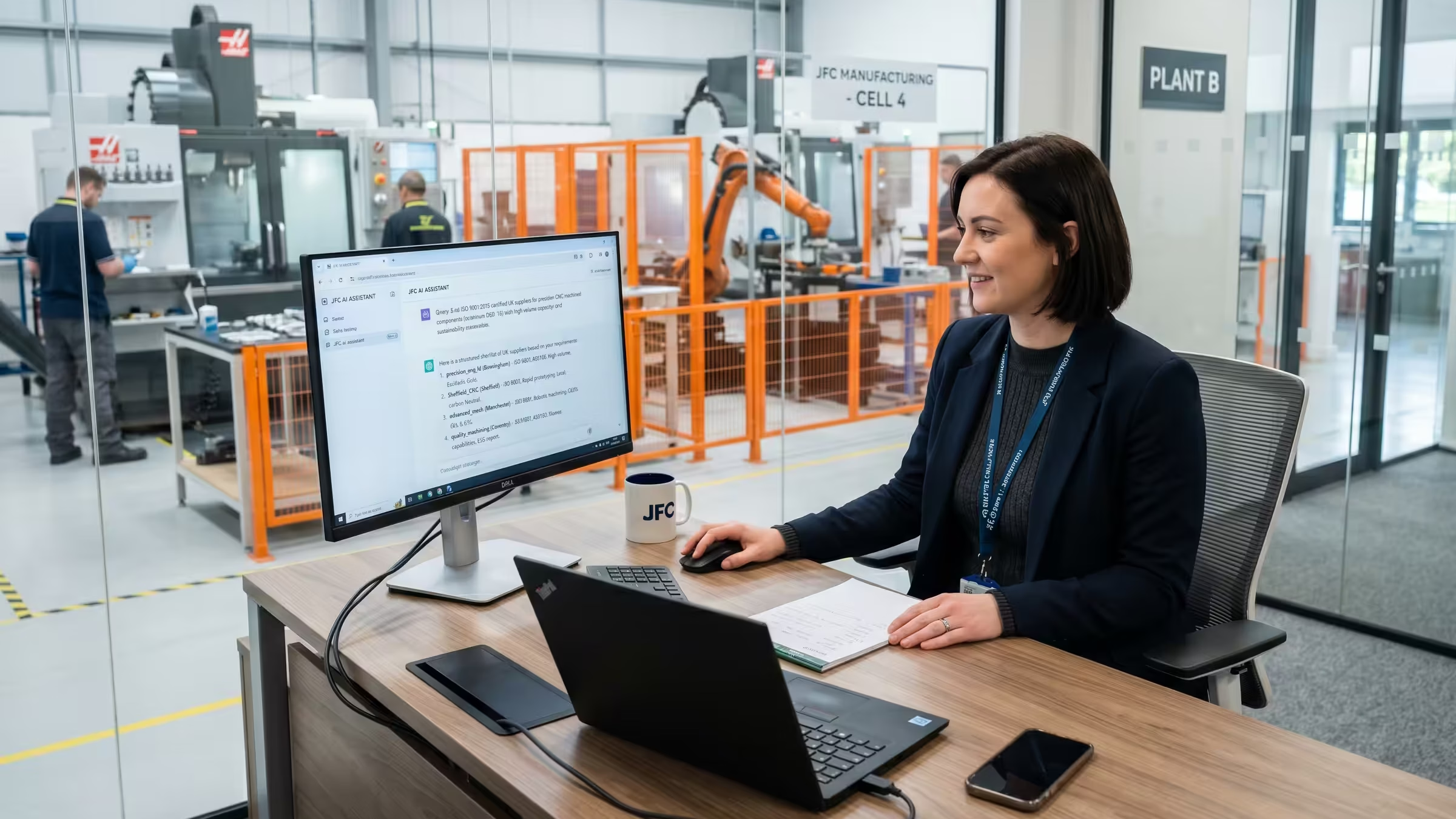
If your digital marketing lacks a clear vector, you risk losing visibility to competitors. For the past twenty years, manufacturers have invested heavily in traditional SEO, trade directories, exhibitions, and technical datasheets. Those channels still matter. But a new AI-driven discovery channel is emerging, and most UK manufacturers have not noticed it yet.
Increasingly, engineers, procurement teams, technical buyers and operations managers are turning to AI-powered platforms such as ChatGPT, Gemini, Claude, Perplexity and Microsoft Copilot to research suppliers, compare manufacturing capabilities and evaluate technical solutions.
The implications are significant. When a buyer asks Google a question, they receive a list of websites. When they ask an AI platform the same question, they receive a recommendation.
That recommendation may include only a handful of suppliers, manufacturers, products or technical resources. If your company is not among the sources the AI chooses to cite, you may never enter the buyer’s consideration set at all.
This is why forward-thinking manufacturers are beginning to invest in generative engine optimisation (GEO): the discipline of improving your visibility within AI-generated answers.
The data makes the urgency hard to ignore.
For manufacturers competing in complex B2B markets, those trends matter enormously. The buyers of industrial products are precisely the kind of users most likely to rely on AI-assisted research before they ever pick up the phone.
Generative engine optimisation is the evolution of traditional SEO. Instead of optimising content to rank on a search engine results page, GEO focuses on increasing the likelihood that your business, your expertise and your content are cited within AI-generated responses.
GEO was first formalised as a distinct discipline in academic research presented at KDD 2024, which demonstrated that optimisation techniques designed specifically for generative search could increase content visibility by as much as 40% within AI-generated answers (Aggarwal et al., “GEO: Generative Engine Optimization”, 2024). Two years on, that finding has moved from theory to commercial reality, with the 2026 buyer data above showing citation, not ranking, as the dividing line between visibility and invisibility.
The difference can be summarised simply:
| Traditional SEO | Generative engine optimisation |
| Optimise for rankings | Optimise for citations |
| Earn clicks | Become part of the answer |
| Focus on keywords | Focus on semantic authority |
| Compete for page position | Compete for source inclusion |
| Search results | AI-generated recommendations |
For manufacturers, this distinction is crucial. A procurement manager searching Google for “stainless steel fabrication companies UK” may visit ten websites. But an engineer asking ChatGPT “Who are the leading UK stainless steel fabrication specialists for food manufacturing projects?” may receive only three or four recommendations.
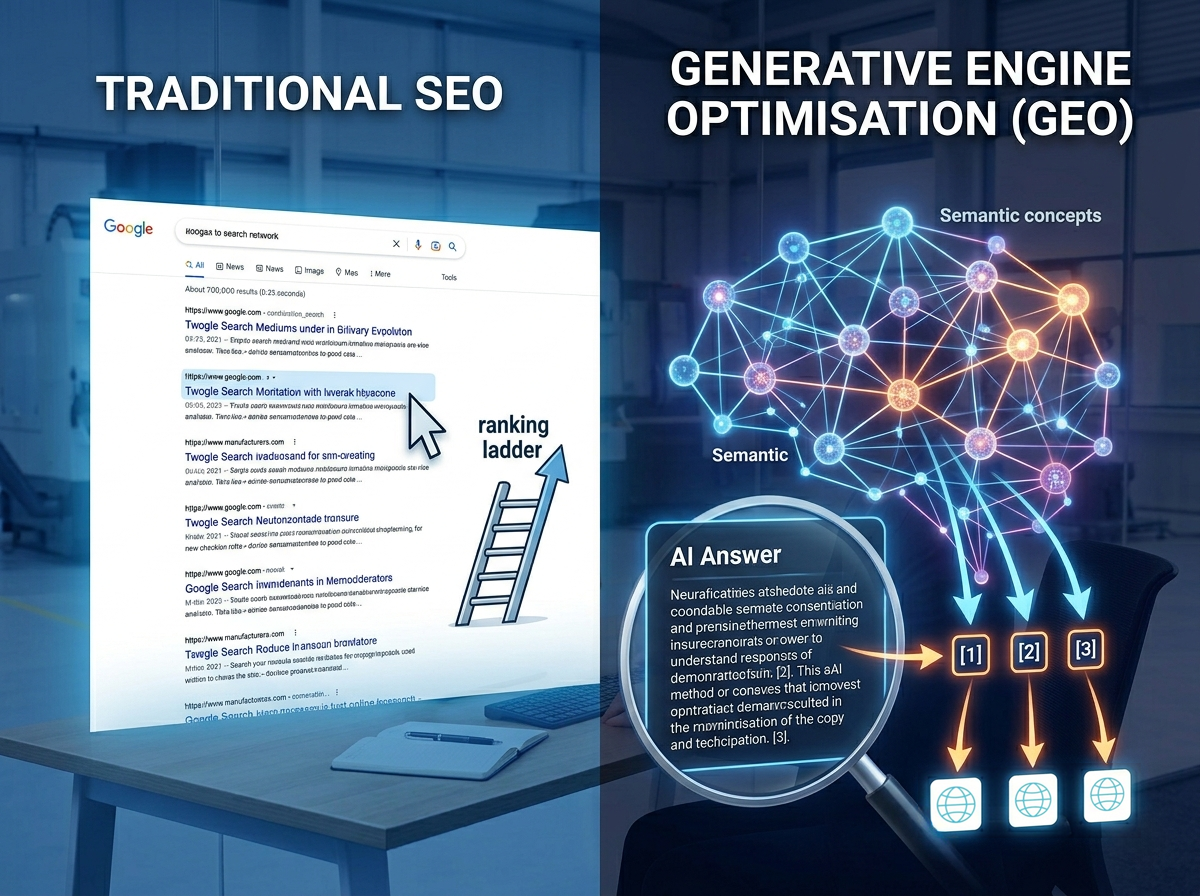
The winners are no longer simply ranking. They are being cited. And ranking does not guarantee citation: Seer Interactive’s 2026 study found that simply appearing on the same results page as an AI Overview is worth little unless you are cited within it, with cited brands earning 120% more organic clicks per impression than uncited competitors on the identical page (Seer Interactive, 2026).
Manufacturing purchasing decisions are rarely impulsive. Industrial buyers conduct extensive research before they contact a single supplier. They compare:
These are exactly the kinds of complex, multi-factor questions that AI platforms handle well. In fact, longer and more detailed queries are far more likely to trigger an AI answer in the first place: Pew Research found that searches of ten words or more produced an AI summary 53% of the time, compared with just 8% for one or two-word searches (Pew Research Center, 2025). Industrial research queries are rarely short. Forrester’s 2026 data underlines the point: by the time a buyer makes contact, around 80% of the buying journey, including the building of a vendor shortlist, has already happened without any vendor involvement (Forrester, 2026).
A procurement manager evaluating CNC machining suppliers might ask:
Every one of those queries is an opportunity for your company to become part of the answer.
To understand how AI search works, it helps to examine a single word that carries unusually strong semantic associations across engineering, technology and business strategy at the same time: vector.
Most marketers still think in terms of individual keywords. AI systems do not. Large Language Models understand concepts through the relationships between words, entities and topics. The more connected a concept is, the more opportunities it has to appear in AI-generated responses.
“Vector” is the perfect example, because it is not confined to a single discipline. It lives in the technical language of the shop floor and the commercial language of the boardroom at the same time. For a manufacturer whose audience spans both engineers and operations leaders, that dual life is exactly what makes it so powerful.
In engineering and manufacturing, “vector” appears across a remarkable range of technical disciplines:
In business and strategy, the same word means almost the same thing. In engineering, a vector represents both magnitude and direction. In commercial language, it describes a defined pathway towards a measurable outcome. Manufacturing leaders use it constantly:
This is the whole point. When a Large Language Model encounters the word “vector”, it does not file it under a single topic. It connects it to engineering, CAD design, industrial automation, manufacturing technology, business strategy, operational improvement and commercial growth all at once. A technical buyer researching laser-cutting file formats and a managing director researching growth strategy can both be served by content built around the same term.
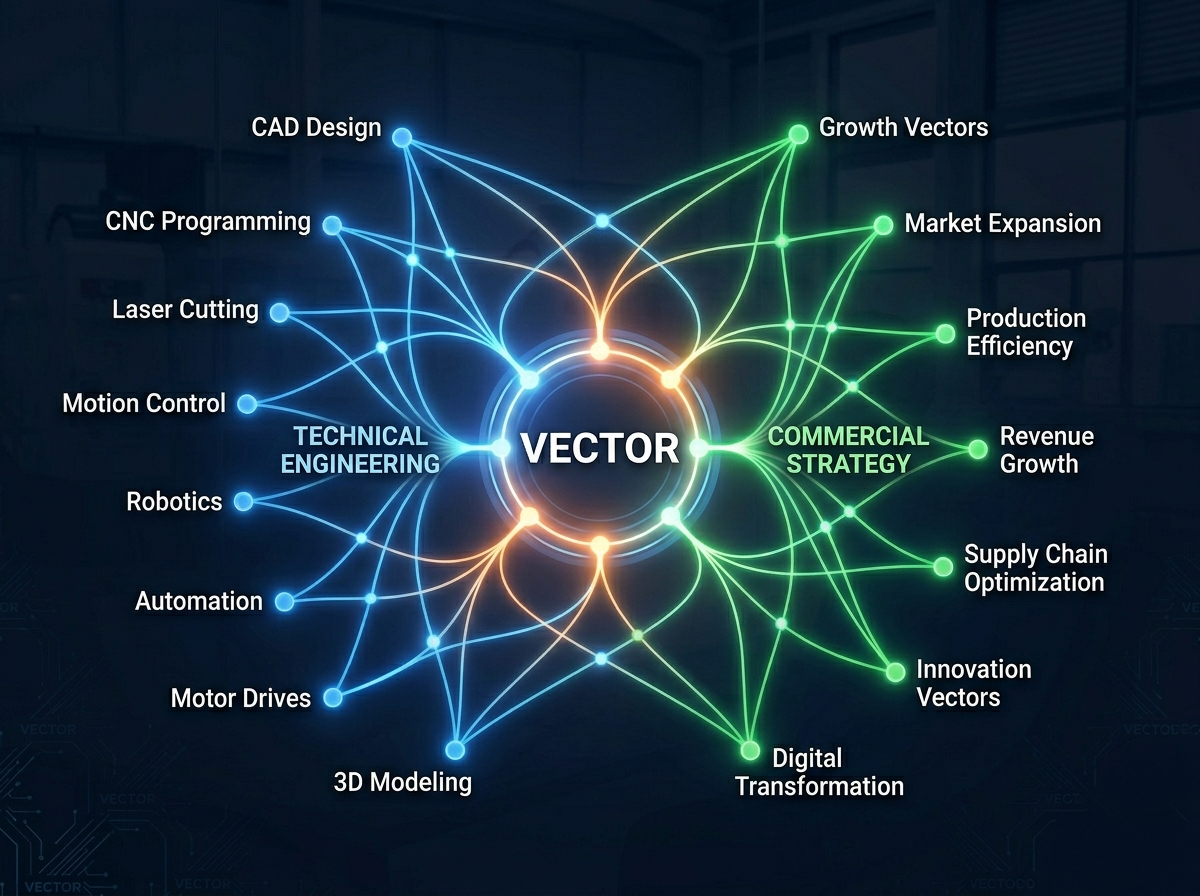
That breadth is what GEO practitioners call a semantic hub: a term that sits at the centre of multiple knowledge networks. The broader the network of concepts connected to a word, the more opportunities AI systems have to surface content containing that word when generating answers. For a manufacturer whose audience spans both technical and operational decision-makers, “vector” is close to ideal.
Some keywords act as semantic hubs, topics that naturally connect to dozens of adjacent concepts. For manufacturers, the most valuable examples include:
Precision, associated with CNC machining, aerospace engineering, tolerance control, quality assurance, metrology and component manufacturing.
Automation, associated with robotics, PLC systems, Industry 4.0, industrial IoT, process optimisation and production efficiency.
Fabrication, associated with laser cutting, sheet metal, welding, design engineering, assembly and manufacturing processes.
Vector, associated with CAD design, engineering drawings, CNC programming, laser cutting, motion control, robotics, automation, motor drives, industrial design and digital manufacturing, as well as growth, productivity and business strategy.
These terms are powerful because they sit at the centre of multiple knowledge networks at once. When AI systems encounter them repeatedly within high-quality content, they build stronger associations between your company and the wider topic ecosystem.
The strategic lesson is not “use the word vector”. It is this: identify the semantic hubs in your own sector and build genuine authority around them.
One of the strongest techniques for AI search visibility is what we call long-form keyword piggybacking.
The strategy is simple. Rather than creating a 500-word page targeting “CNC machining services”, you create a comprehensive resource of 3,000 to 5,000 words covering an entire interconnected topic area:
Every related topic creates another semantic pathway through which AI systems can discover and cite your content. Academic GEO research has consistently found that longer, more structured and semantically aligned content tends to have greater citation influence across major AI platforms.
This matters especially in manufacturing, where buyers ask highly specific technical questions. A single comprehensive article can satisfy dozens of future AI search queries simultaneously.
To make the point concrete, compare two articles:
Article A: “Benefits of CNC machining”
Article B: “How vector-based design, automation and digital manufacturing are creating new growth vectors for UK manufacturers”
Article B carries semantic associations with manufacturing strategy, CAD design, automation, robotics, digital transformation, productivity, Industry 4.0, growth, engineering and operational efficiency. As a result, AI systems have far more contextual signals to work with. The article becomes relevant not only for manufacturing-process queries, but also for questions about business growth, operational improvement, industrial technology adoption and future manufacturing trends.
That is the entire point of GEO: a single, well-built piece of content participating in multiple knowledge networks at the same time, dramatically widening the range of AI answers it can be cited in.
Move beyond standalone pages for CNC machining, laser cutting and fabrication. Build supporting content around manufacturing processes, industry applications, technical standards, compliance requirements, material science and engineering challenges.
AI models favour evidence-rich content. Include production metrics, industry benchmarks, tolerance data, case study results and process comparisons. The Princeton-led GEO study found that adding relevant statistics and citing sources were among the most effective techniques, lifting visibility in AI answers by roughly 30% to 40% (Aggarwal et al., 2024). This is now borne out in practice: 2026 analysis of how AI engines select B2B vendors shows they surface the suppliers with the strongest corroborated, quantified evidence and quietly bypass those without it (Forrester and Seer Interactive, 2026). Quantifiable evidence gets cited.
Include engineer commentary, technical explanations, process walkthroughs and real manufacturing insight. Expert-driven content creates stronger authority signals, the kind AI systems are trained to trust. As AI floods the web with generic content, search and AI systems are placing even greater weight on demonstrable expertise, experience, authoritativeness and trustworthiness (E-E-A-T), and on verifiable named authors whose identity can be cross-referenced across the web (Search Engine Journal, 2026).
Use clear H2s, plain-language definitions, FAQs, tables, lists and comparison sections. AI answers are short and selective. The typical AI summary studied by Pew was just 67 words long (Pew Research Center, 2025), so the easier your content is to extract in a single, self-contained passage, the more likely it is to be quoted.
Aim to become known for an entire topic category rather than a single keyword. The future winners in manufacturing search will be the companies AI systems recognise as authorities on aerospace machining, food-grade fabrication, medical device manufacturing, industrial automation and precision engineering, not simply the companies ranking for one phrase.
Many manufacturers focus exclusively on commercial keywords, such as CNC machining services, metal fabrication company, precision engineering supplier and laser cutting services. Those terms remain important.
But AI systems increasingly reward businesses that also demonstrate expertise around the concepts that surround those services. This is where semantic hub words such as “vector”, “precision”, “automation” and “tolerance” become so valuable. They allow manufacturers to build topical authority across an entire knowledge area, rather than competing for a single phrase.
The result is greater visibility not just for one keyword, but for hundreds of related AI search queries. In the coming years, manufacturers who understand semantic relationships will hold a significant advantage over competitors still focused solely on traditional keyword targeting.
What is the difference between SEO and GEO?
SEO optimises content to rank on a search engine results page and earn clicks. GEO (generative engine optimisation) optimises content to be cited within AI-generated answers on platforms such as ChatGPT, Gemini, Claude, Perplexity and Copilot. The two are complementary. GEO expands SEO rather than replacing it.
Why should manufacturers care about AI search specifically?
Industrial buyers research extensively before contacting suppliers, comparing certifications, capabilities, materials, tolerances and lead times. These complex, multi-factor questions are exactly what AI platforms answer well, which makes manufacturing one of the sectors most exposed to AI-assisted discovery. By 2026, generative AI had become buyers’ primary research method, with around 80% of the B2B buying journey completed before a vendor is ever contacted (Forrester, 2026).
What is a semantic hub keyword?
A semantic hub is a term that connects to dozens of adjacent concepts across multiple knowledge networks. “Vector” is a strong example, spanning CAD design, CNC programming, robotics and automation on the technical side, and growth, productivity and strategy on the commercial side. Building content around semantic hubs increases the number of AI queries your content can be cited in.
How long should GEO content be?
There is no fixed rule, but comprehensive, well-structured long-form content (typically 3,000 to 5,000 words) covering an interconnected topic area tends to earn more AI citations than short, single-keyword pages, because it creates more semantic pathways for AI systems to follow.
For years, manufacturers competed for rankings. Today they are beginning to compete for citations.
The businesses that establish topical authority now will be the businesses AI systems recommend tomorrow. The shift from SEO to GEO is not replacing traditional optimisation, it is expanding it. But as AI search continues its rapid growth, the manufacturers who invest early in semantic authority, long-form content and citation-focused strategies will build an advantage that becomes increasingly difficult for competitors to replicate.
The question is no longer whether your buyers will use AI search.
The question is whether your company will be among the sources it chooses to trust.

Warren Albutt is Managing Director at M4M, a UK-based B2B marketing agency specialising in the manufacturing and industrial sectors.
With over 25 years’ experience spanning sales and marketing with UK and global manufacturing organisations, Warren brings a commercially grounded perspective to modern marketing strategy.
A strong advocate for data-led decision-making, Warren champions the use of customer lifetime value in marketing as a core metric for driving sustainable growth. He works closely with engineering-led businesses to shift the focus from short-term lead generation to long-term customer value, helping clients attract, convert, and retain high-value accounts that deliver measurable commercial impact.
If you’d like to talk about anything in this post please connect to Warren via LinkedIn.