



Search is changing rapidly.
This GEO glossary has been created to explain the most important GEO and AI SEO terminology in plain English. No unnecessary jargon. No overcomplicated technical language. Just practical explanations to help businesses understand how AI-driven search is evolving and what it means for their online visibility
People are no longer just typing keywords into Google. They are asking questions to AI platforms, using conversational search tools and relying on generated answers instead of traditional search results.
AI-powered search and chat tools have scaled faster than almost any previous consumer technology.
Industry analysts (including Gartner) have repeatedly highlighted AI as a “major shift in search behaviour”, predicting significant disruption to traditional search models over the coming years.
Multiple SEO industry studies estimate that around 50% to 65% of Google searches end without a click.
That shift has introduced a whole new language of digital marketing terminology.
From GEO and semantic SEO to entities and AI overviews, many businesses are hearing these terms for the first time often without clear explanations of what they actually mean.
Whether you are a marketer, manufacturer, B2B company or business owner, this GEO glossary will help you better understand how AI platforms discover, interpret and recommend content online.
GEO stands for Generative Engine Optimisation (our GEO Glossary will help you understand in more detail).
It is the process of optimising your website and digital content so AI-powered search platforms can understand, trust and reference your business within generated answers.
Unlike traditional SEO, which focuses heavily on rankings and keywords, GEO focuses more on:
Examples of generative search platforms include:
AI search is changing how people discover businesses online.
Instead of clicking through multiple search results, users increasingly receive direct AI-generated answers. Businesses that provide trustworthy, structured and authoritative content are more likely to be referenced by these systems.
That means visibility is no longer just about ranking first on Google. It is increasingly about becoming the trusted source AI platforms choose to mention. Read this GEO glossary thoroughly and feel free to give us a call if you want to talk through how this may effect your business.
AI SEO is a modern approach to search optimisation designed for both traditional search engines and AI-powered answer engines.
It combines:
The goal is to help content perform well across:
Traditional SEO often focused heavily on:
AI SEO still values those elements, but also prioritises:
The future of search is becoming less about “gaming algorithms” and more about genuinely helping users. Throughout this GEO glossary we refer to practical improvements you, your current agency or S2F can do to improve your AI presence.
An AI answer engine is a platform that generates direct responses to user questions instead of simply listing web pages.
Examples include:
These systems analyse information from multiple sources to create conversational answers.
If your website content is clear, authoritative and easy for AI systems to understand, your business is more likely to appear within generated answers.
Our GEO glossary show how you can create a major opportunity for brands, like yours, willing to adapt early.
Semantic SEO is the process of creating content around topics and meaning rather than simply repeating keywords. Although this GEO glossary is focused on GEO, sematic SEO is still an important part of your GEO journey.
Search engines and AI platforms now try to understand:
For example, a page about “industrial automation” may also naturally include:
This helps AI systems understand the broader topic rather than relying on exact keyword repetition.
AI systems are designed to understand language more like humans do.
That means content written naturally, comprehensively and contextually often performs better than content written purely for keywords.
Our GEO glossary is helpful, but If you like to learn more practical examples of what can be done contact us on info@s2fmarketing.co.uk
Entities are specific people, companies, locations, products or concepts that search engines can clearly identify and understand.
For example:
AI search systems use entities to connect information across the web.
Strong entity signals help search engines and AI tools understand:
To will learn from our GEO glossary that consistent branding, clear website structure and third-party mentions are becoming increasingly important.
Topical authority is the level of trust and expertise your website demonstrates around a particular subject.
Rather than publishing random content, authoritative websites build clusters of high-quality content around a specialist area.
For example, a manufacturing marketing agency might create content about:
Over time, AI platforms begin recognising that business as a trusted source within that niche. You can see throughout this helpful guide we have still used a keyword ‘GEO glossary’ but the important part is this is informative, helpful and written with authority.
Usually through:
EEAT stands for:
These are quality signals used by search engines and AI systems to evaluate content credibility.
AI platforms want to provide users with reliable information.
That means content created by experienced professionals with genuine expertise is more likely to perform well.
Businesses can strengthen EEAT by including:
A generic article written by AI alone may struggle to compete with content written by an experienced industry specialist who includes:
Human expertise is becoming more valuable, not less. Our GEO glossary is an example of proving experience, knowledge and, in time, will lead to trust.
Structured data is code added to a website that helps search engines understand content more clearly.
It provides extra context about:
Think of structured data as labels for AI systems.
It helps search engines quickly understand:
Structured data can improve visibility in:
Schema markup is the vocabulary used within structured data.
It creates standardised labels that search engines recognise.
For example:
AI systems rely heavily on structured understanding.
Schema markup helps provide:
This can improve how AI platforms interpret your content.
Conversational search refers to users searching in natural language rather than short keyword phrases.
For example, instead of searching:
“best CRM software”
A user may ask:
“What is the best CRM software for a small manufacturing business?”
AI platforms are designed around conversational behaviour.
Content should answer real questions naturally.
This includes:
The best GEO content often sounds more human and less robotic.
AI Overviews are AI-generated summaries that appear directly within search results.
These summaries aim to answer user questions instantly by combining information from multiple sources.
Why do AI overviews matter?
They are changing how users interact with search engines.
Instead of clicking multiple websites, users may receive answers immediately.
This means businesses must optimise content not only for clicks, but also for citations and visibility inside generated answers.
Zero-click search happens when a user gets the answer they need without clicking on a website.
This is increasingly common with:
Not necessarily.
Even when users do not click immediately, appearing within trusted answers can:
Visibility is evolving beyond traditional traffic metrics. Be prepared you may start to see a drop is website traffic. This is NOT a bad thing if you are replacing it with AI visibility this GEO glossary give you those practical tips to help improve that presence.
llms.txt is an emerging website file designed to help AI systems understand which content should be accessed and interpreted.
It works similarly to robots.txt but is focused more on large language models (LLMs).
As AI search evolves, websites may increasingly use llms.txt to:
It is still developing, but many SEO professionals are monitoring it closely.
Vector search is a method AI systems use to understand meaning and similarity between pieces of content.
Rather than matching exact keywords, vector search helps AI platforms identify related ideas and context.
It explains why modern SEO is becoming more semantic and less keyword-dependent.
AI systems increasingly understand:
This is why natural, comprehensive writing performs better than keyword stuffing.
Retrieval Augmented Generation, often called RAG, is a process where AI systems retrieve external information before generating an answer.
This helps AI platforms provide:
Businesses with authoritative, accessible content are more likely to become trusted sources referenced by AI systems using RAG processes.
This is one reason why:
are becoming increasingly valuable. This is a prime example of how an AI systems can retrieve external information, like this GEO glossary, before generating an answer
Multimodal search combines different types of inputs, including:
AI systems can increasingly interpret multiple content formats together.
Content strategies should no longer focus only on written pages.
Businesses should also consider:
The future of search is becoming more interactive and more visual.
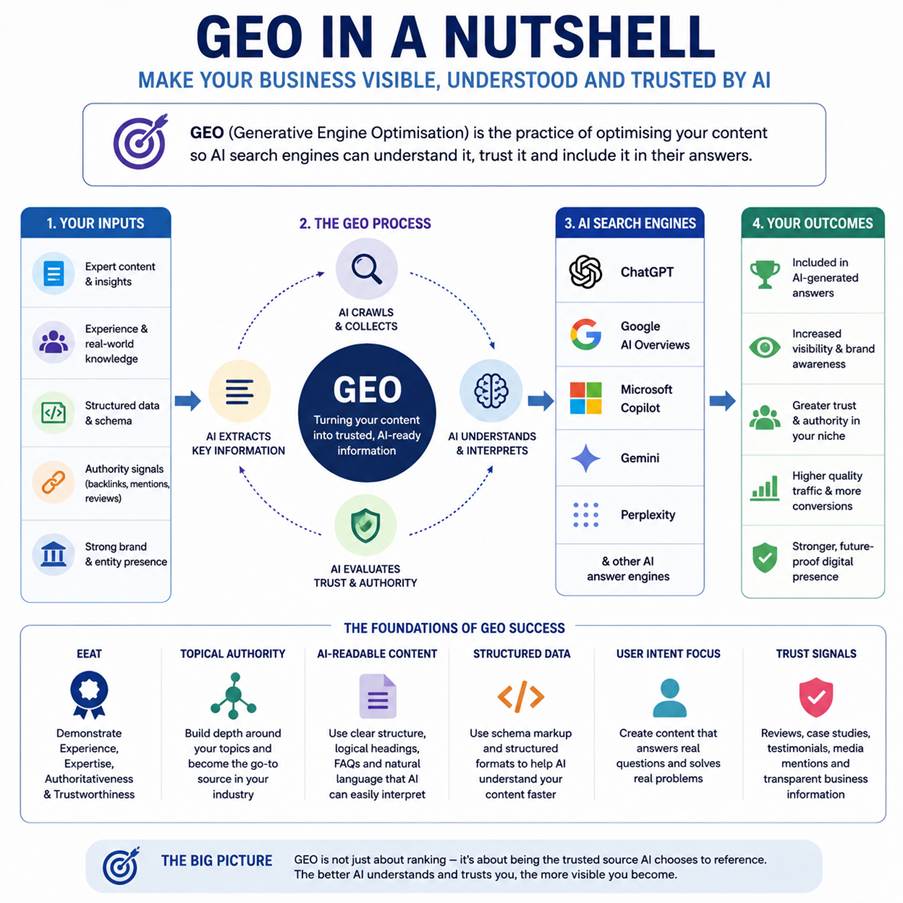
AI-readable content is content that is easy for AI systems to interpret, summarise and reference.
This usually means content that is:
Simple improvements include:
Good GEO content is usually easier for humans to read too.
AI-powered search is not replacing SEO, it is reshaping it.
Businesses that focus on:
are likely to be in the strongest position moving forward.
GEO is ultimately about making your business easier for both humans and AI systems to understand, trust and recommend.
And in a world increasingly driven by generated answers, that visibility could become one of the most valuable digital assets a business can build.
Businesses can no longer rely purely on traditional rankings.
The focus is shifting towards:
The brands preparing now are likely to gain a major competitive advantage over the next few years.
For manufacturing and engineering brands, GEO success is driven by:
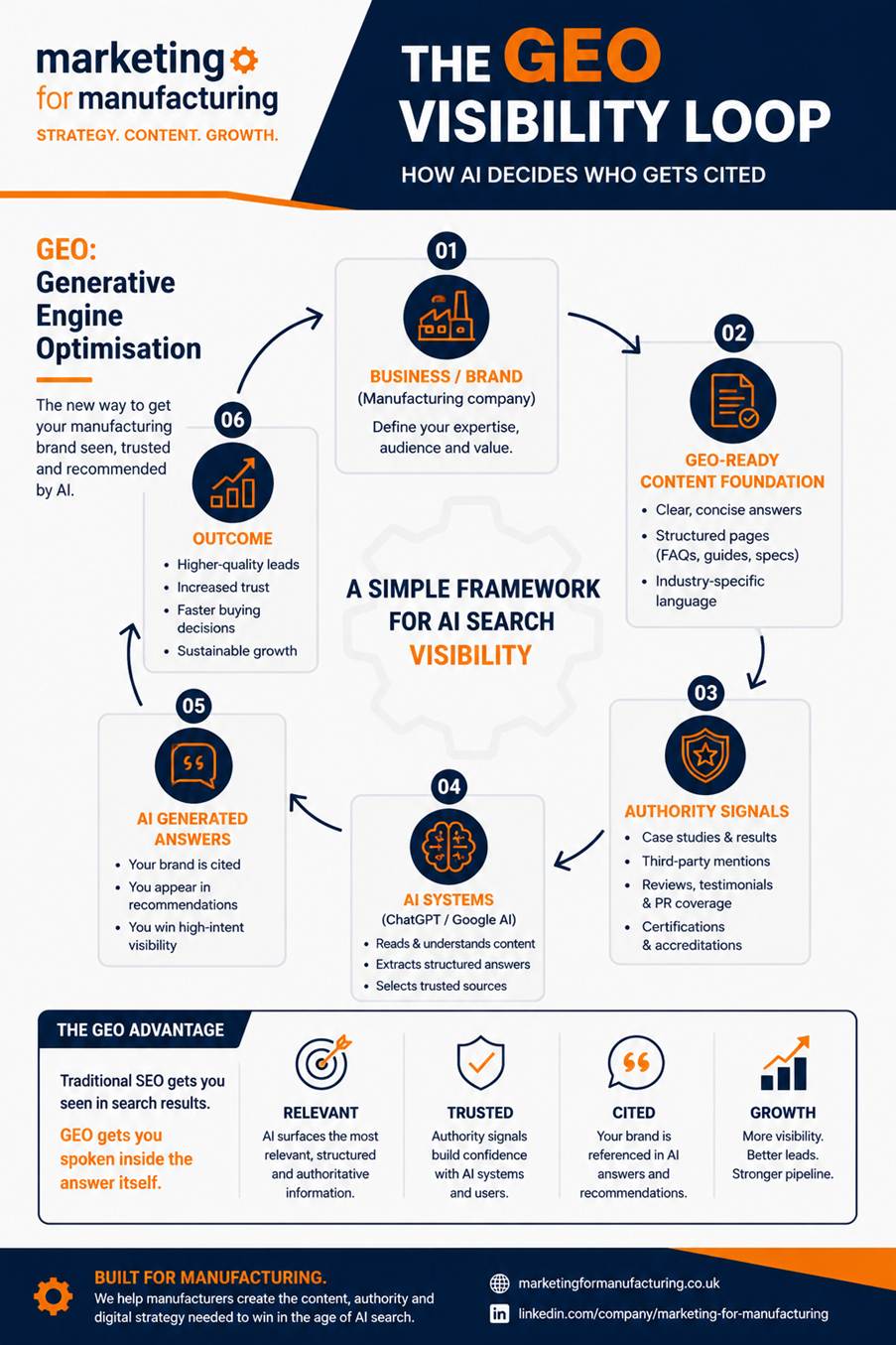
feel free to copy and paste this image of our GEO Glossary to help your own AI strategy.

Warren Albutt is Managing Director at M4M, a UK-based B2B marketing agency specialising in the manufacturing and industrial sectors.
With over 25 years’ experience spanning sales and marketing with UK and global manufacturing organisations, Warren brings a commercially grounded perspective to modern marketing strategy.
A strong advocate for data-led decision-making, Warren champions the use of customer lifetime value in marketing as a core metric for driving sustainable growth. He works closely with engineering-led businesses to shift the focus from short-term lead generation to long-term customer value, helping clients attract, convert, and retain high-value accounts that deliver measurable commercial impact.
He hopes this GEO Glossary helps your AI ranking strategy. If you’d like to talk about anything in this guide please connect to Warren via LinkedIn.