



Manufacturing marketing strategy is not about doing more marketing. It is about doing the right marketing, for the right customers, with the right message, at the right time, and being able to prove that it contributes to sales.
This is a practical, expert-led guide showing UK manufacturers how to turn marketing activity into a focused, measurable strategy that generates qualified leads, sales opportunities and sustainable business growth.
For many UK manufacturers, marketing still sits somewhere between the sales department and the managing director’s desk.
There may be a website. There may be a LinkedIn page. There may be a brochure, a trade show programme, occasional email campaigns and perhaps an SEO agency producing monthly reports.
But when someone asks a deceptively simple question “Where are our next £1 million of sales coming from?” marketing can struggle to provide the answer.
That is the difference between marketing activity and a manufacturing marketing strategy.
A strategy should not simply tell you what to post on LinkedIn next Tuesday. It should establish which markets you want to win, which customers you want to attract, why they should choose you, how you will reach them, what you need to say, how sales and marketing will work together and, ultimately, how you will measure whether the investment is generating commercial growth.
At Marketing for Manufacturing, we have spent years working with manufacturers, engineering businesses and industrial organisations where the sales process can be technical, lengthy and involve multiple decision-makers. Our experience has shown us that manufacturers rarely need more random marketing activity. They need clarity, consistency and commercial direction.
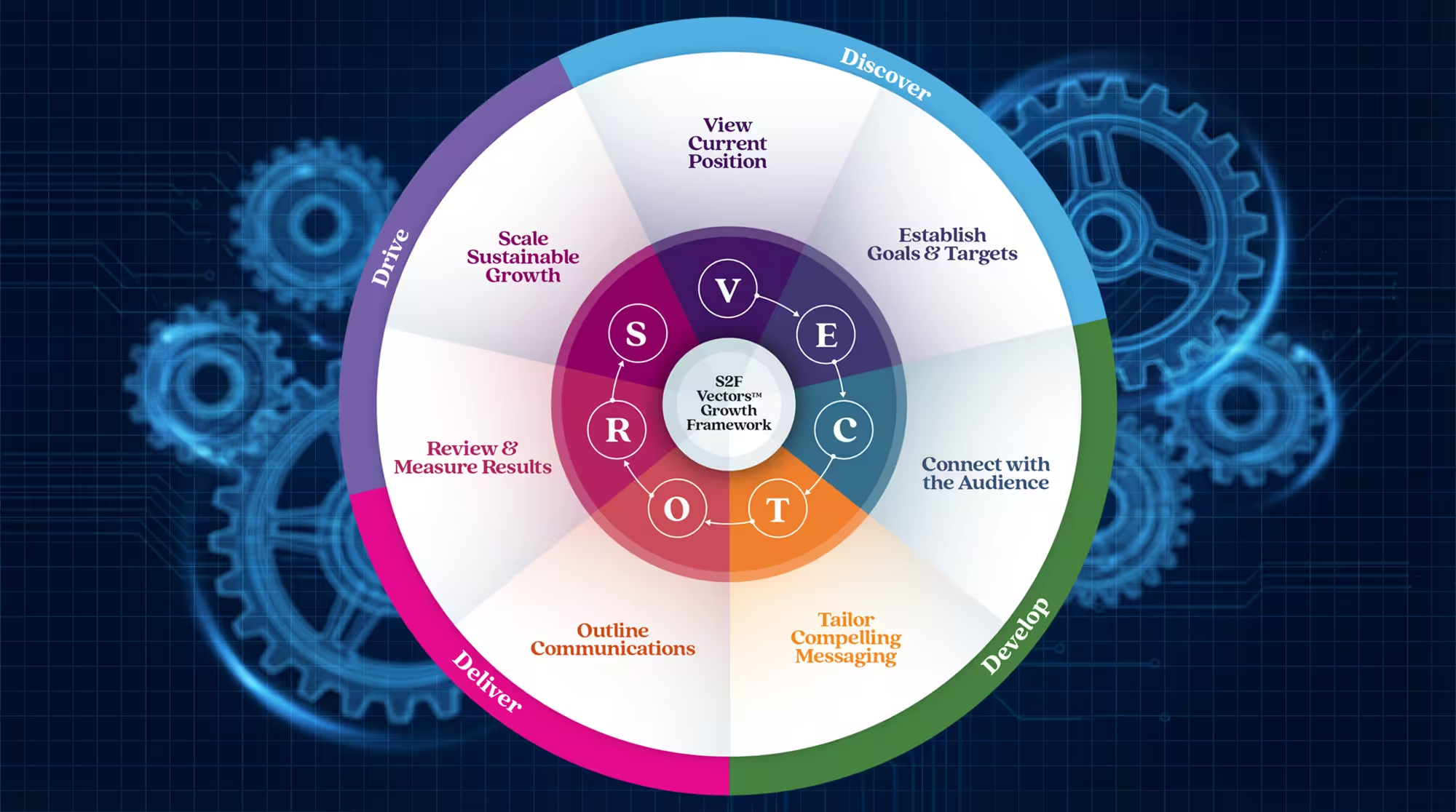
That is why we developed the S2F VECTORS Growth Framework™ a seven-stage approach designed specifically around the realities of manufacturing and industrial B2B marketing.
This guide explains how to build a manufacturing marketing strategy that is designed to generate sales rather than simply generate activity.
A manufacturing marketing strategy is a commercially focused plan that connects your business objectives with your target markets, customers, proposition, communications, marketing channels and measurable sales outcomes.
It answers seven fundamental questions:
That sounds straightforward. In practice, manufacturing makes each question considerably more complicated.
A manufacturer might sell to OEMs, Tier 1 suppliers, distributors and direct customers simultaneously. The person searching Google might be an engineer. The person requesting a quotation might be procurement. The person approving the supplier could be a technical director, operations director or managing director.
And the person ultimately using the product may be somebody else entirely. Consequently, a manufacturing marketing strategy cannot simply target “business owners” or “procurement managers”.
It needs to understand the entire buying journey.
One of the most common problems we see is that manufacturers start with the marketing channels rather than the commercial problem.
The conversation becomes:
“We need to do more LinkedIn.”, “Our website needs updating.”, “Should we be doing Google Ads?”, “Our competitor is doing videos, so perhaps we should.”
These aren’t marketing strategies. They are tactics.
A successful manufacturing marketing strategy starts somewhere else:
Business objective → market opportunity → ideal customer → buying problem → proposition → message → channel → campaign → measurement → sales.
For example, imagine a precision engineering company with £8 million turnover that wants to reach £12 million. The answer isn’t automatically “increase marketing spend by 50%”. First, you need to understand the £4 million gap.
Perhaps the company has spare production capacity, it wants to move away from low-margin work, it has invested in new CNC machinery and needs higher-value contracts, it wants to enter aerospace, or perhaps it wants more UK customers rather than relying on three large accounts.
Each scenario requires a completely different manufacturing marketing strategy. The starting point is the commercial objective, not the marketing channel.
Our approach is built around the S2F VECTORS Growth Framework™:
V — View
E — Establish
C — Connect
T — Tailor
O — Outline
R — Review
S — Scale
It is designed to turn strategic thinking into practical marketing action.
Let’s look at each stage.
Before deciding where you are going, you need an honest view of where you are now. This is where many marketing strategies go wrong. Businesses jump straight into activity without establishing a baseline. A proper manufacturing marketing audit should consider:
But there is another question that is often overlooked, what is your sales team telling you? Your sales team is an extraordinary source of market intelligence. Rember its sales & marketing not sales v marketing. They know:
That information should feed directly into your marketing strategy. Marketing shouldn’t operate in isolation from sales. It should make sales more effective.
Our approach to monitoring marketing ROI also starts with establishing clear objectives, baselines and meaningful measures rather than relying on vanity metrics such as impressions or likes.
Once you understand your starting point, establish where you need marketing to take you. This is where a marketing plan becomes commercially accountable.
Don’t start with: “We want more website traffic.”
Ask: “What does the business actually need to achieve?”
For example:
Business objective: Increase annual revenue from £8m to £12m.
Marketing objective: Create a predictable pipeline of qualified opportunities within two target sectors.
Sales objective: Generate an additional £6m of qualified opportunities to support the £4m revenue target.
This creates a line of sight between marketing investment and commercial performance.
Did marketing create opportunities that sales can convert?
For a manufacturer, useful KPIs could include:
| Marketing measure | Commercial question |
| Qualified enquiries | Are we attracting the right prospects? |
| RFQs | Is marketing influencing genuine buying activity? |
| Conversion rate | Is our website turning interest into action? |
| Opportunity value | Is the pipeline commercially significant? |
| Cost per qualified lead | Are we spending efficiently? |
| Marketing-influenced revenue | Is marketing contributing to sales? |
| Sales cycle | Are prospects moving through the buying journey? |
| Customer acquisition cost | Is growth sustainable? |
Manufacturers often describe their audience using an industry e.g.:
That’s a starting point, not a target audience. You need to understand the people inside those markets. A typical manufacturing buying group might include:
Interested in:
Interested in:
Interested in:
Interested in:
Interested in:
The same manufacturer may need to communicate with all five. But they shouldn’t necessarily receive the same message. This is why manufacturing marketing needs to move beyond generic buyer personas.
You need to map the technical buying journey.
A manufacturing buyer rarely wakes up one morning and thinks, “Today I shall purchase £750,000 worth of engineering services.” The journey usually begins much earlier. It might start with:
Your marketing needs to support every stage. That means a manufacturing website shouldn’t simply contain a list of services. It should answer the questions your customers have before they are ready to contact you.
This is one reason our digital marketing approach for manufacturers combines SEO, content, case studies, technical information and digital channels rather than treating them as isolated activities.
This is arguably one of the biggest opportunities for manufacturing businesses. Manufacturers are incredibly good at explaining what they do.
They can tell you:
All of this information is important. But it isn’t necessarily persuasive.
Your customer is asking: “What does all of this mean for me?”
That is where marketing needs to translate technical capability into commercial value.
For example:
Technical message: “We operate five-axis CNC machining centres capable of producing complex components to tight tolerances.”
Commercial message: “Complex precision components manufactured accurately first time, reducing rework, delays and costly production disruption.”
The technical capability provides the proof. The commercial benefit provides the reason to care. You need both.
A strong proposition should answer four questions:
For example:
“We manufacture precision metal components for aerospace and advanced engineering businesses that need reliable, repeatable production without compromising quality or delivery.”
Then prove it with:
This is also where E-E-A-T becomes commercially important. Our article on how manufacturers can use E-E-A-T to improve AI visibility explores why experience, expertise, authoritativeness and trustworthiness matter when manufacturers are trying to become visible in modern search and AI-generated answers.
Only now should you decide which marketing channels you need. The right manufacturing marketing strategy doesn’t try to do everything. It selects the channels that best reach your audience and move prospects through the buying journey.
Optimise for the searches your potential customers actually make. That includes technical searches, product searches, application searches, problem searches, sector searches and geographic searches.
For example:
The objective isn’t simply to rank. It is to be found when buying intent exists.
Your website should act as a 24/7 sales and technical resource. It should make it easy for a prospect to understand:
Useful content can include:
Our experience is that case studies are particularly powerful because they transform claims about capability into evidence of results.
For many B2B manufacturers, LinkedIn is an important channel for reaching decision-makers, engineers, procurement professionals and potential partners. But don’t turn your company page into a catalogue.
A prospect who isn’t ready to buy today shouldn’t necessarily disappear from your marketing database. Long manufacturing buying cycles make nurturing particularly valuable. Useful content can keep your company relevant until the prospect is ready to engage.
Digital marketing hasn’t killed exhibitions. It has changed how successful manufacturers use them. Your exhibition strategy should begin before the event and continue long after the stand has been dismantled.
Pre-event: Identify → target → invite → book meetings
During the event: Engage → demonstrate → capture → qualify
After the event: Follow up → educate → nurture → convert
Our manufacturing trade show marketing guidance takes the same approach: exhibitions work best when they are treated as part of an integrated campaign rather than a three-day standalone event.
There is another fundamental change manufacturers need to consider.
Your potential customer isn’t only asking Google anymore.
They may ask:
The question is no longer simply, “Can Google find my website?” It increasingly becomes, “Does the available evidence make my business worthy of being recommended?”
That makes expertise, authority, proof, structured information and useful content increasingly important. For manufacturers, this is an enormous opportunity.
You already possess the raw material for authoritative content:
The marketing strategy should turn that expertise into searchable, useful and credible digital knowledge.
This is where many manufacturing marketing programmes fall down. Marketing reports often focus on:
These can be useful diagnostic measures. But they aren’t the end game. If marketing is supposed to generate growth, you need to follow the journey through to commercial outcomes.
Imagine this:
A manufacturer spends £15,000 on a campaign.
It produces:
Now you have something meaningful to discuss with the board. The question isn’t, “Did the campaign get good engagement?” It’s “Did the campaign create commercially valuable opportunities?”
For manufacturers, attribution can be difficult because sales cycles can stretch over months.
A prospect might:
No single channel “won” the customer. The marketing strategy needs to recognise the whole customer journey.
The final stage of VECTORS is Scale. This is where data becomes decision-making. If you discover that aerospace content generates high-value enquiries, create more.
If a particular product page consistently generates RFQs, improve and promote it. If a trade show generates large numbers of poor-quality leads, reconsider the event. If LinkedIn generates engagement but no commercial opportunities, change the targeting or content.
If SEO creates a steady stream of qualified enquiries, continue building authority.
If a sector is growing faster than expected, consider creating a dedicated campaign around it.
Don’t scale activity. Scale results. That distinction is critical.
Let’s take a hypothetical engineering manufacturer.
Turnover: £8 million / Target turnover: £12 million / Growth requirement: £4 million
The business currently generates most of its revenue from repeat customers and wants to win more aerospace and advanced engineering work.
The business has spare production capacity and strong technical capability but low brand awareness outside its traditional customer base.
Primary:
Secondary:
Not simply:
“We are a precision engineering company.”
Instead:
“A reliable UK precision manufacturing partner for complex aerospace components where quality, repeatability and delivery are critical.”
Create:
Use:
Marketing identifies target accounts, sales prioritise them.
Marketing creates relevant content; sales use that content.
Marketing monitors engagement, sales follow up with active prospects.
Both teams review the pipeline.
Track:
Target accounts → engagement → enquiries → RFQs → opportunities → orders → revenue
Now marketing has become part of the growth strategy.
Before you launch your next campaign, ask:
If you can’t answer these questions confidently, your business probably doesn’t need more marketing activity. It needs a better manufacturing marketing strategy.
Manufacturing marketing is not simply B2B marketing with pictures of machinery added.
A good manufacturing marketing strategy therefore needs to understand the commercial and technical environment in which the business operates.
That means understanding:
Our guide to choosing a manufacturing marketing agency sets out some of the practical characteristics to look for, including technical content expertise, understanding complex sales cycles, meaningful commercial KPIs and genuine manufacturing experience.
The reason we developed the S2F VECTORS Growth Framework™ was simple. Manufacturers don’t need another manufacturing marketing strategy plan that sits in a PowerPoint presentation for six months.
They need a framework that can be used.
V — View: Understand your current position, market, competitors, performance and opportunities.
E — Establish: Set measurable commercial goals and marketing targets.
C — Connect: Understand your audiences, buying groups and customer journeys.
T — Tailor: Develop propositions and messages that turn technical capability into commercial value.
O — Outline: Build the right combination of website, SEO, content, LinkedIn, email, events, PR, paid media and sales enablement.
R — Review: Measure performance against meaningful commercial KPIs.
S — Scale: Invest more heavily in the activity that demonstrably contributes to sustainable growth.
The result is a marketing strategy that isn’t simply a document. It becomes a manufacturing marketing strategy that focuses in growth.
Manufacturing businesses are accustomed to measuring things.
You measure production output, scrap rates, machine utilisation, quality, delivery, margins.
Marketing should be no different. You should know:
That is what turns marketing from an annual list of activities into a genuine commercial growth strategy. And perhaps the most important point is this:
You don’t need to do everything. You need to do the right things consistently.
A focused manufacturing marketing strategy aimed at the right customers, with a compelling proposition, strong evidence and measurable campaigns will almost always outperform a collection of disconnected marketing activities.
For ambitious UK manufacturers, that is where the real opportunity lies.
A manufacturing marketing strategy is a structured plan that connects a manufacturer’s commercial objectives with its target customers, value proposition, marketing channels, content, sales activity and measurable outcomes. Unlike a generic marketing plan, it needs to account for technical products, complex buying groups, long sales cycles and procurement processes.
A strategy helps manufacturers prioritise their marketing investment around the markets, customers and products that offer the greatest commercial opportunity. Without a strategy, businesses can end up spending money on disconnected activities that generate visibility but little measurable sales impact.
Manufacturing often involves highly technical products, long sales cycles and multiple decision-makers. Engineers, procurement professionals, operations teams, quality managers and directors may all influence the same purchasing decision. Marketing therefore needs to provide relevant information and evidence for different stakeholders throughout the buying journey.
It depends on the objectives and channels. Paid campaigns and targeted LinkedIn activity can generate early engagement relatively quickly, while SEO, technical content and authority building typically require several months to establish momentum. Manufacturing sales cycles can also be lengthy, so success should be measured across the complete journey from first interaction to opportunity and revenue.
There is no single best channel for every manufacturer. SEO, websites, technical content, LinkedIn, email marketing, paid advertising, PR, account-based marketing and trade shows can all play a role. The right combination depends on your customers, products, markets, sales cycle and objectives.
Yes, particularly where potential customers research suppliers online. Manufacturing SEO should go beyond generic keywords and target technical products, applications, sectors, problems and buyer questions. Content should also demonstrate genuine expertise and evidence.
Increasingly, yes. Buyers can use AI tools to research suppliers, technologies and solutions. Manufacturers should therefore consider how their expertise, technical information, case studies, credentials and online authority can be understood and surfaced by AI-powered search experiences as well as traditional search engines.
Start by defining exactly what a qualified lead means for your business. Then target specific customer segments, develop messaging around their commercial and technical problems, create useful content, build sector-specific landing pages and ensure marketing and sales share responsibility for lead qualification and follow-up.
There is no universal percentage that applies to every manufacturing business. Marketing investment should be based on growth objectives, margins, customer acquisition economics, sales cycle and the opportunity available. The more useful question is not “What percentage should we spend?” but “What level of marketing investment is required to generate our target pipeline and revenue?”
It doesn’t have to be either/or. Some manufacturers have strong internal marketing teams but need specialist strategic support, technical content expertise, SEO or campaign resources. Others outsource most or all marketing. The important thing is having the right expertise and capacity to execute the strategy effectively.
At minimum, it should cover business objectives, market analysis, target customers, buyer journeys, positioning, messaging, competitive differentiation, channel strategy, content, sales alignment, budgets, KPIs, measurement and an implementation roadmap.
The S2F VECTORS Growth Framework™ is Marketing for Manufacturing’s proprietary seven-stage approach to manufacturing marketing strategy: View, Establish, Connect, Tailor, Outline, Review and Scale. It is designed to help manufacturing and engineering businesses turn marketing from disconnected activity into a measurable commercial growth programme.
If your manufacturing business is investing in marketing but isn’t confident about where the next opportunities will come from, it may be time to step back from the individual tactics and look at the bigger picture.
At Marketing for Manufacturing, we work with ambitious manufacturing, engineering and industrial businesses to develop practical marketing strategies built around their commercial objectives.
The S2F VECTORS Growth Framework™ provides the structure to understand where you are today, identify where you want to go, connect with the right customers, develop compelling messaging, activate the right channels, measure performance and scale what works.
The objective isn’t more marketing.
It’s more of the right marketing — generating better opportunities, stronger pipelines and sustainable growth.
Talk to us about your manufacturing marketing strategy
If you’d like to understand where your current marketing is performing, where the gaps are and where the greatest opportunities for growth may lie, talk to the Marketing for Manufacturing team.
Let’s stop guessing what marketing should do and start engineering it around the growth your business wants to achieve.
Explore our manufacturing marketing strategy service
Explore Marketing for Manufacturing

Warren Albutt is Managing Director at M4M, a UK-based B2B marketing agency specialising in the manufacturing and industrial sectors.
With over 25 years’ experience spanning sales and marketing with UK and global manufacturing organisations, Warren brings a commercially grounded perspective to modern marketing strategy.
A strong advocate for data-led decision-making, Warren champions the use of customer lifetime value in marketing as a core metric for driving sustainable growth. He works closely with engineering-led businesses to shift the focus from short-term lead generation to long-term customer value, helping clients attract, convert, and retain high-value accounts that deliver measurable commercial impact.
If you’d like to talk about anything in this post please connect to Warren via LinkedIn.